
The short answer
Gentle stretches for lower back pain include the knee-to-chest stretch, pelvic tilt, cat-cow, child's pose, glute bridge, bird dog and a figure-4 hip stretch. Move slowly, stay in a mild stretch, and stop if pain shoots down your leg or you feel numbness. For common low back pain, NIAMS advises avoiding bed rest and gradually increasing activity as you can tolerate it.
- Keep every stretch mild; never push into sharp pain.
- Skip bed rest and build activity back gradually.
- Stop and call a doctor if pain shoots down your leg.
- An exam lets a chiropractor tailor exercises to your back.
If your lower back aches after a long day at a desk or a slow crawl through Los Angeles traffic, a few minutes of gentle movement may help you feel looser. The seven stretches below are simple, need no equipment and can be done on a rug or mat at home.
Think of them as a starting point. At Okhowat Chiropractic, these same moves often become part of a corrective exercise plan, where Dr. Okhowat picks and adjusts each exercise after examining how your spine and hips actually move.
Why gentle movement usually beats bed rest for low back pain
When your back hurts, lying down all day can feel like the safe choice. For common back pain, though, the National Institute of Arthritis and Musculoskeletal and Skin Diseases (NIAMS) advises avoiding bed rest. Instead, it suggests limiting what causes pain and gradually increasing activity as you can tolerate it.
NIAMS also notes that strengthening exercises can help decrease pain, and that you should check with your doctor or physical therapist before starting any exercise routine. That is why these moves are slow and easy to scale back.
NIAMS also lists a desk job as a possible factor, especially with poor posture or a full day in an uncomfortable chair. If screens are a big part of your day, the guide to tech neck covers the upper half of the same problem.
Pain that lasts longer than 12 weeks is what doctors call chronic. The page on chronic back pain explains common causes and how care is approached when pain lingers.
Safety first: who should check with a doctor, and when to stop
Gentle stretching suits most people, but not everyone at every moment. Check with a doctor first if any of these apply to you.
- Your back pain started after a fall, car accident or other injury.
- You have osteoporosis, a recent fracture or a history of spine surgery.
- You are pregnant (ask your OB which positions are safe for you).
- Your pain has not improved after a few weeks.
- You have pain, numbness or tingling that travels into a leg.
Once you begin, use a simple traffic-light rule. It helps you tell the difference between a normal stretch and a warning sign.
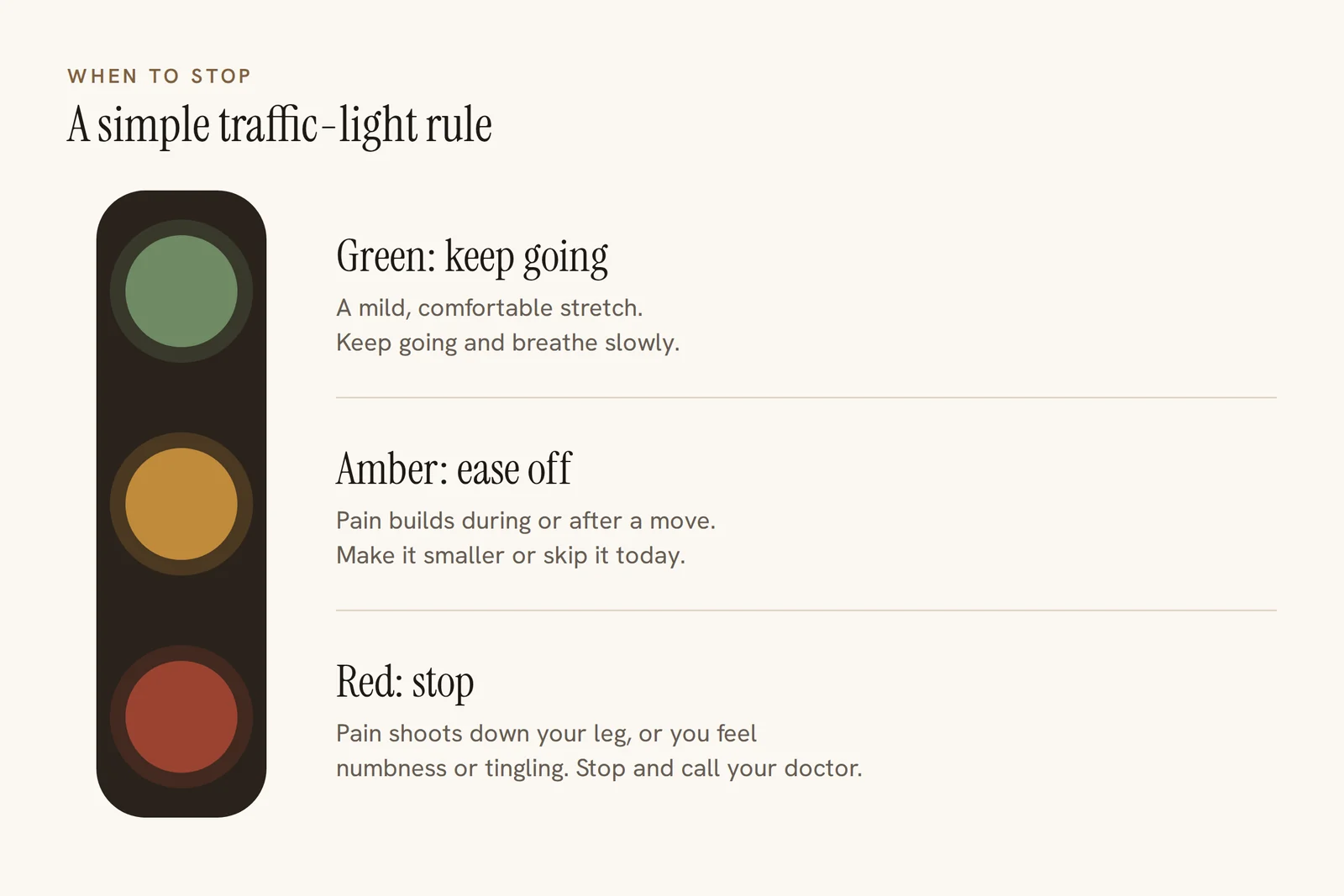
- Green: you feel a mild, comfortable stretch. Keep going and breathe slowly.
- Amber: your pain increases during or after a move. Ease off, make the movement smaller or skip that stretch for the day.
- Red: pain shoots down your leg, or you feel numbness or tingling. Stop the routine and call your doctor.
Pain that travels down the leg deserves a proper check. The sciatica pain relief guide explains what that can mean and which options people commonly explore.
See a doctor right away if
- You have trouble urinating or lose control of your bladder or bowels
- You notice numbness in your groin or inner thighs
- Weakness in a leg or foot is getting worse
- Back pain comes with a fever or weight loss you did not intend
- Your pain began after a fall or serious injury
- Severe back pain does not improve with medication
In an emergency, call 911. Otherwise, please see a physician or urgent care before booking chiropractic care.
Before you start: a quick checklist
A little setup makes these stretches safer. Run through this list first.
Before you start
- You have checked with a doctor if any of the safety points above apply
- You have a mat, rug or carpet and room to lie flat
- You have walked around for a few minutes to warm up
- You plan to move slowly, with no bouncing or forcing
- You will breathe out as you stretch and never hold your breath
- You know your stop signs: shooting leg pain, numbness or rising pain
If you are sore, start with fewer reps than listed. Finishing a little looser beats pushing through and paying for it tomorrow.
Want exercises chosen for your back instead of a generic list? Book a consultation so Dr. Okhowat can examine how you move first.
Stretches for lower back pain: moves 1 to 4
These first four are mobility moves for a stiff lower spine and hips. Each lists the steps, a starting dose and where you should feel it.
1. Knee-to-chest stretch
- Lie on your back with both knees bent and feet flat on the floor.
- Hold behind one knee with both hands and gently draw it toward your chest.
- Keep the other foot on the floor and let your lower back relax.
- Hold, lower slowly and switch legs.
Dose: hold 20 to 30 seconds, 2 or 3 times per side. Feel it here: a gentle stretch across your lower back and the back of your hip.
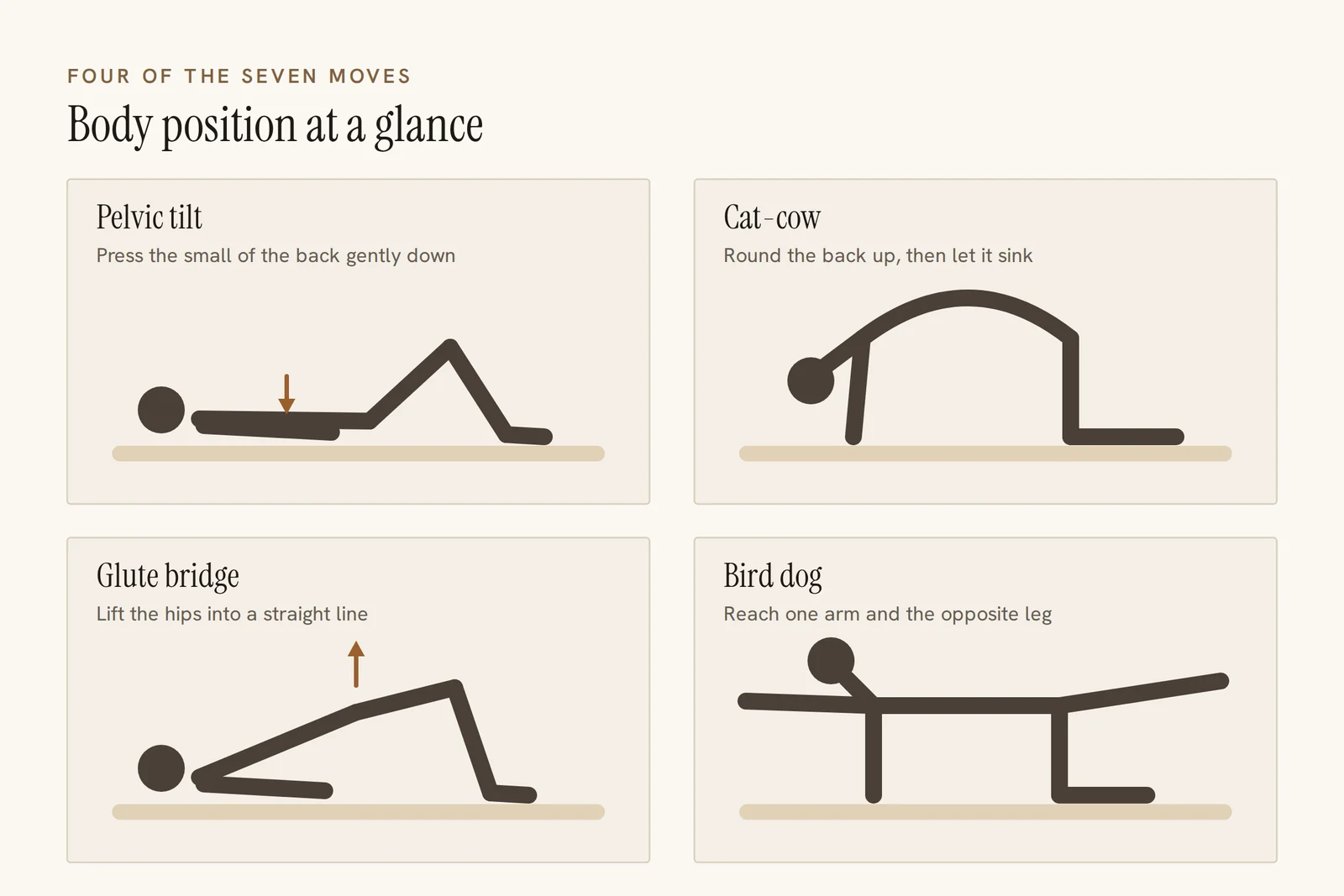
The illustration below shows four of the moves in this guide: the pelvic tilt, cat-cow, glute bridge and bird dog. Use it as a quick reference for body position.
2. Pelvic tilt
- Lie on your back with knees bent and feet flat, hip-width apart.
- Tighten your stomach muscles and gently press the small of your back into the floor.
- Your pelvis will rock slightly. Keep your buttocks resting on the floor.
- Hold, then relax.
Dose: hold 5 seconds, repeat 8 to 10 times. Feel it here: light effort in your lower stomach and an easing in your lower back.
3. Cat-cow
- Start on hands and knees, hands under shoulders and knees under hips.
- Breathe in and let your belly sink gently as you look slightly forward (cow).
- Breathe out and round your back toward the ceiling, tucking your chin (cat).
- Move slowly between the two positions.
Dose: 8 to 10 slow rounds. Feel it here: a gentle, rolling movement through your whole spine, with no pinching.
4. Child's pose
- From hands and knees, sit your hips back toward your heels.
- Reach your arms forward and rest your forehead on the floor or a pillow.
- Let your knees widen if that feels better for your hips.
- Breathe slowly into your back.
Dose: hold 20 to 30 seconds, 2 or 3 times. Feel it here: a broad stretch along your lower and middle back.
Exercises for lower back pain: moves 5 to 7
The last three moves add gentle strength and open up the hips. NIAMS notes that weak back and stomach muscles may not properly support the spine, which is why light core work belongs in the mix.
5. Glute bridge
- Lie on your back with knees bent, feet flat and hip-width apart.
- Tighten your stomach and squeeze your buttocks.
- Lift your hips until your body forms a straight line from shoulders to knees.
- Hold briefly, then lower slowly.
Dose: hold 3 to 5 seconds, repeat 8 to 10 times. Feel it here: your buttocks and the backs of your thighs. If you feel it mostly in your lower back, lift a little lower.
6. Bird dog
- Start on hands and knees with a flat back.
- Tighten your stomach as if bracing for a light poke.
- Slowly reach one arm forward and the opposite leg back, keeping your hips level.
- Hold, return and switch sides.
Dose: hold 5 seconds, 6 to 8 times per side. Feel it here: your stomach, back and buttocks working together to keep you steady. If balance is hard, start with just the leg reach.
7. Figure-4 (piriformis) stretch
- Lie on your back with both knees bent.
- Cross your right ankle over your left knee, making a figure 4.
- Hold behind your left thigh and gently draw it toward your chest.
- Hold, release and switch sides.
Dose: hold 20 to 30 seconds, 2 or 3 times per side. Feel it here: deep in the buttock of the crossed leg. Stop if you feel tingling down the leg.
A gentle weekly plan (an example, not a prescription)
Here is one simple way to fit these stretches into a week. It is a general example for everyday back stiffness, not a personal plan, so adjust it to how you feel and follow your doctor's advice if it differs.
| Day | Moves | Time |
|---|---|---|
| Monday | Knee-to-chest, pelvic tilt, cat-cow, child's pose | About 10 minutes |
| Tuesday | Glute bridge, bird dog, figure-4 stretch | About 10 minutes |
| Wednesday | Easy walk, then cat-cow and child's pose | 15 to 20 minutes |
| Thursday | All 7 moves at the low end of each dose | About 15 minutes |
| Friday | Pelvic tilt, glute bridge, bird dog | About 10 minutes |
| Saturday | Easy walk or light activity, then figure-4 stretch | 15 to 20 minutes |
| Sunday | Rest, or knee-to-chest and child's pose if stiff | About 5 minutes |
Weekends in LA often mean a hike in Griffith Park or up Runyon Canyon. If that is your plan, build your distance up gradually after time off, and use a few cat-cows and knee-to-chest stretches to wind down afterward.
What corrective exercise means at a chiropractic office
A list of stretches treats every back the same. Corrective exercise works differently: the exercises are chosen after an exam to address the specific movement or posture pattern behind your pain.
One person's back pain may come with stiff hips. Another may sit rounded all day, or have limited range of motion after an old injury. Their exercises would look quite different.
That is the thinking behind corrective exercises at Okhowat Chiropractic. They can be paired with postural and ergonomic training, so the daily habits that strain your back get attention too.
How Dr. Okhowat builds a corrective exercise plan
Dr. Okhowat has been in practice since 1999 and has over 25 years of experience. He earned his Doctor of Chiropractic degree at Cleveland Chiropractic College and is licensed by the California Board of Chiropractic Examiners.
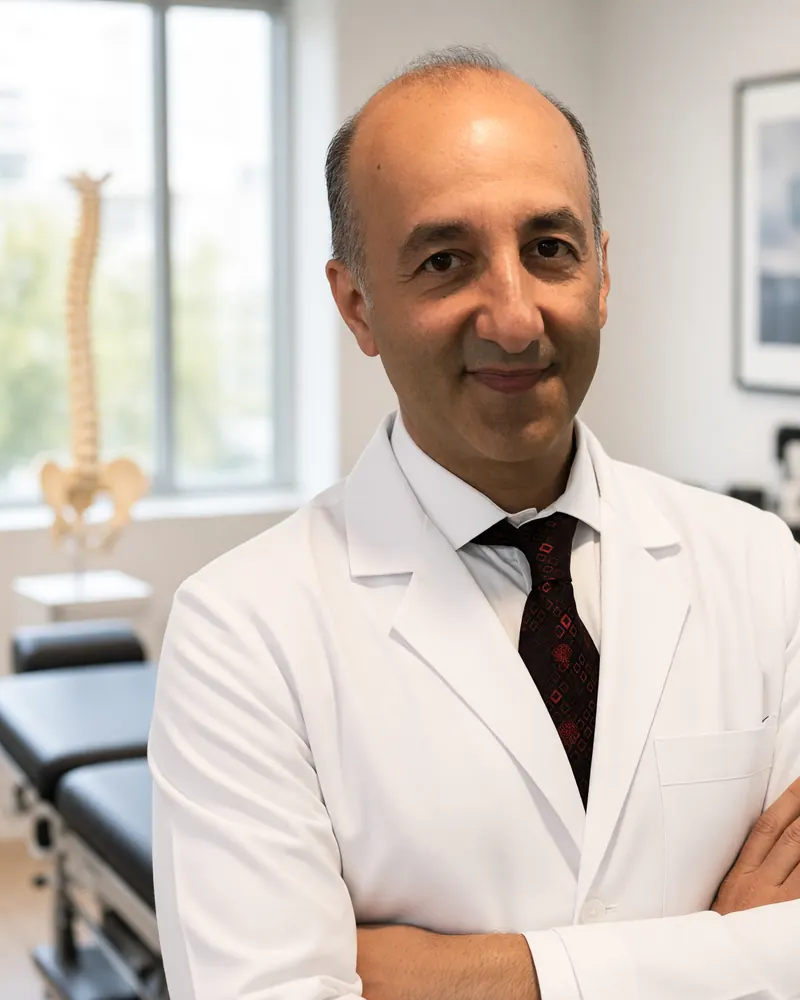
A first visit at the office on Wilshire, just west of Fairfax, generally follows these steps.
- Consultation: a conversation about your pain, your work, your commute and your goals.
- Assessment: a look at your posture, movement, joints and muscles, plus screening for anything a physician should see first.
- Personalized plan: what he found, what he recommends, how often and how you will know it is working.
- Hands-on care: this may include spinal adjustments, soft tissue work and corrective exercise.
- Recovery and prevention: building strength, posture and daily habits so you can keep moving.
Chiropractic care is one conservative option for low back pain, not the only one. Because screening is part of the assessment, anything that needs a physician can be flagged before treatment begins.
Ready to go beyond a generic routine? You can contact Okhowat Chiropractic or call (323) 933-3357. Hours are Monday to Thursday 9 AM to 9 PM and Friday 9 AM to 5 PM.
Book a consultation and let Dr. Okhowat build a corrective exercise plan around what your exam shows.
Questions readers ask
How often should I do stretches for lower back pain?
Many people do gentle stretches once a day or on most days, keeping each session short. If a move makes your pain worse, cut back and ask for a routine matched to your back.
Should I stretch when my lower back is hurting?
Gentle movement is usually fine for common back pain if you stay in a mild stretch. NIAMS advises avoiding bed rest and building activity back gradually. If pain shoots down your leg or you feel numbness, stop and call a doctor.
Which stretches should I avoid with lower back pain?
Skip any stretch that causes sharp pain, shooting pain or tingling, and avoid bouncing or forcing a position. When in doubt, choose the gentlest version or leave it out until you have been examined.
How long does it take for back stretches to help?
It varies from person to person. NIAMS says most people with back pain find relief within 6 weeks. If your pain is not improving after a few weeks, see a doctor to look for the cause.
How many chiropractic visits will I need for lower back pain?
It depends on what your exam shows, how long you have had pain and how your body responds. Dr. Okhowat explains his findings and a recommended visit frequency in your plan, along with how you will know it is working.
Does insurance cover corrective exercise at a chiropractor?
Coverage varies from plan to plan. Okhowat Chiropractic accepts insurance, so call (323) 933-3357 to check your plan before your first visit.
Sources
- NIAMS: Back Pain: Overview, Symptoms, and Causes
- NIAMS: Back Pain: Diagnosis, Treatment, and Steps to Take

About the author
Dr. Okhowat earned his Doctor of Chiropractic degree at Cleveland Chiropractic College and has practiced in Los Angeles since 1999. He is licensed by the California Board of Chiropractic Examiners and is a member of the American Chiropractic Association and the California Chiropractic Association.
- DC, Cleveland Chiropractic College
- AAIM Fellow
- AAIM Diplomate, Manipulative and Body Based Practices
- Over 25 years of experience
This article is general information, not medical advice, and is not a substitute for an exam. Please talk with a qualified provider about your situation. Individual results vary.