

The short answer
Sciatica pain relief usually starts with gentle movement instead of bed rest, ice or heat, and a few easy stretches. Cleveland Clinic notes that many cases improve within four to six weeks. If pain lasts longer, keeps getting worse, or comes with weakness or bladder or bowel changes, get checked by a provider.
- Sciatica is a symptom of another problem, not a diagnosis.
- Light activity usually helps more than days of bed rest.
- Stop any stretch that sends pain shooting down your leg.
- Weakness or bladder or bowel changes need care right away.
What is sciatica?
If you have pain that starts in your lower back or buttock and travels down one leg, you may be dealing with sciatica. It can feel like anything from a dull ache to a sharp, electric jolt, and it is one of the most common causes of leg pain.
Here is the key point: sciatica is a symptom, not a diagnosis. MedlinePlus describes it as a sign of another medical problem rather than a condition by itself. Real sciatica pain relief starts with finding out what is irritating the nerve.
Where the sciatic nerve runs
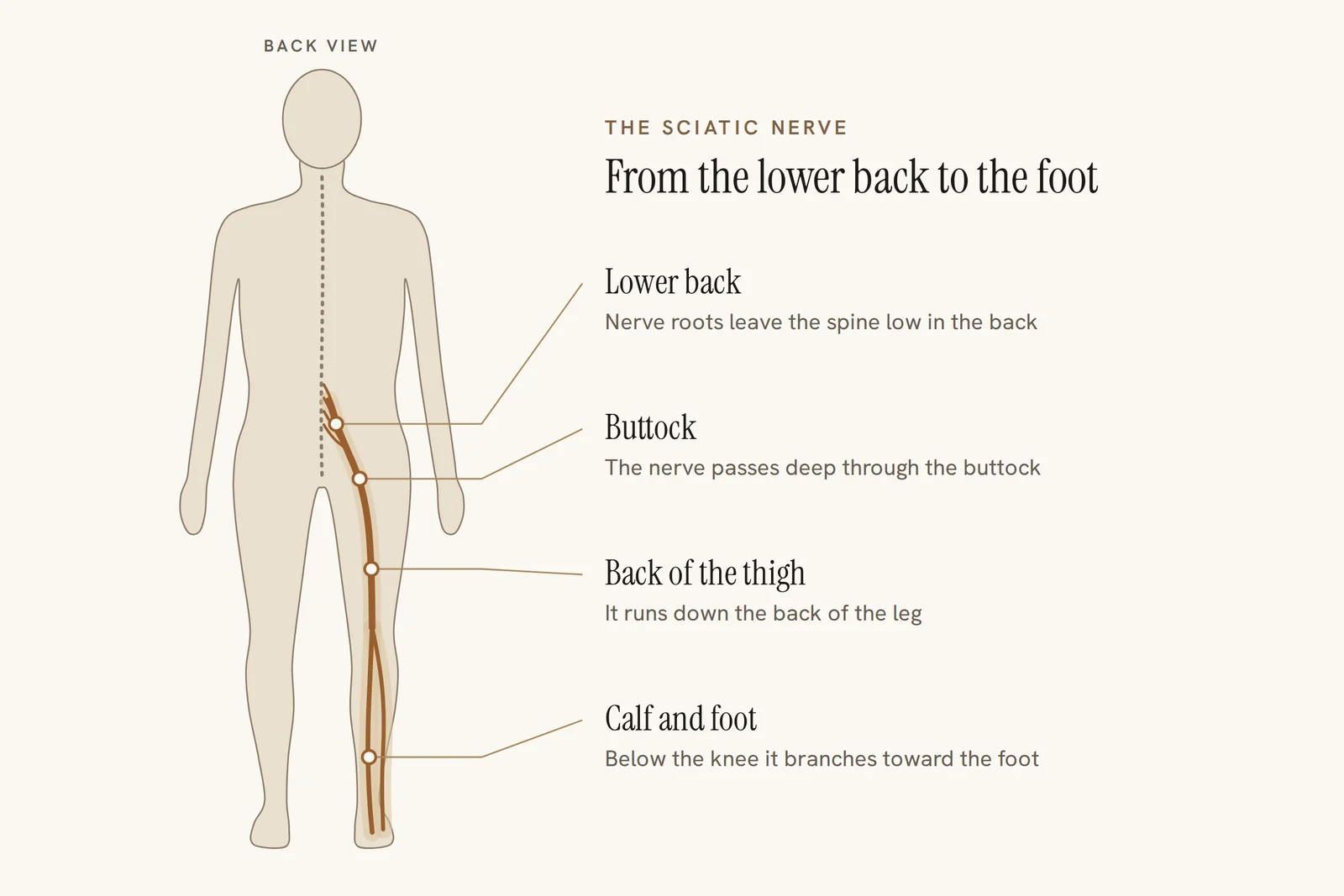
The sciatic nerve is the largest nerve in your body, and you have one on each side. It starts near the base of your spine, passes through your pelvis and buttock, then runs down the back of your thigh into your lower leg.
Because the nerve is so long, pressure at one spot can cause symptoms far away. That is why a problem in your lower back can show up as numbness in your calf or the sole of your foot. The diagram below traces its path.
How sciatica feels
Sciatica usually affects one side of the body. Many people describe a burning or electric shock feeling that shoots down one leg. Others notice a mild tingle, a dull ache, or pins and needles in the foot or toes.
Certain moves tend to make it flare. According to Cleveland Clinic and MedlinePlus, sciatic nerve pain may get worse:
- When you cough, sneeze or laugh
- After you stand or sit for a while
- At certain times of day, such as at night
- When you bend, or lift a straight leg while lying on your back
The affected leg may also feel weak. Some people notice their foot catching on the ground as they walk. That detail is worth mentioning to any provider you see.
Sciatica, a pulled muscle or piriformis syndrome?
Not every pain in the back of the leg is sciatica. The table below shows some general patterns. Treat it as a rough guide only, since these problems can overlap and only an exam can sort them out.
| What you notice | Sciatica from the spine | Pulled muscle | Piriformis syndrome |
|---|---|---|---|
| Where it starts | Lower back, then down one leg | In the strained muscle itself | Deep in the buttock |
| How it feels | Burning, shooting or electric, often with numbness or tingling | Sore, tight and tender to the touch | Deep buttock ache that may travel down the leg |
| What sets it off | Coughing, sneezing, bending or sitting | A recent strain, lift or hard workout | Long sitting with pressure on the buttock |
| Nerve signs like tingling or weakness | Common | Uncommon | Possible |
What causes sciatica?
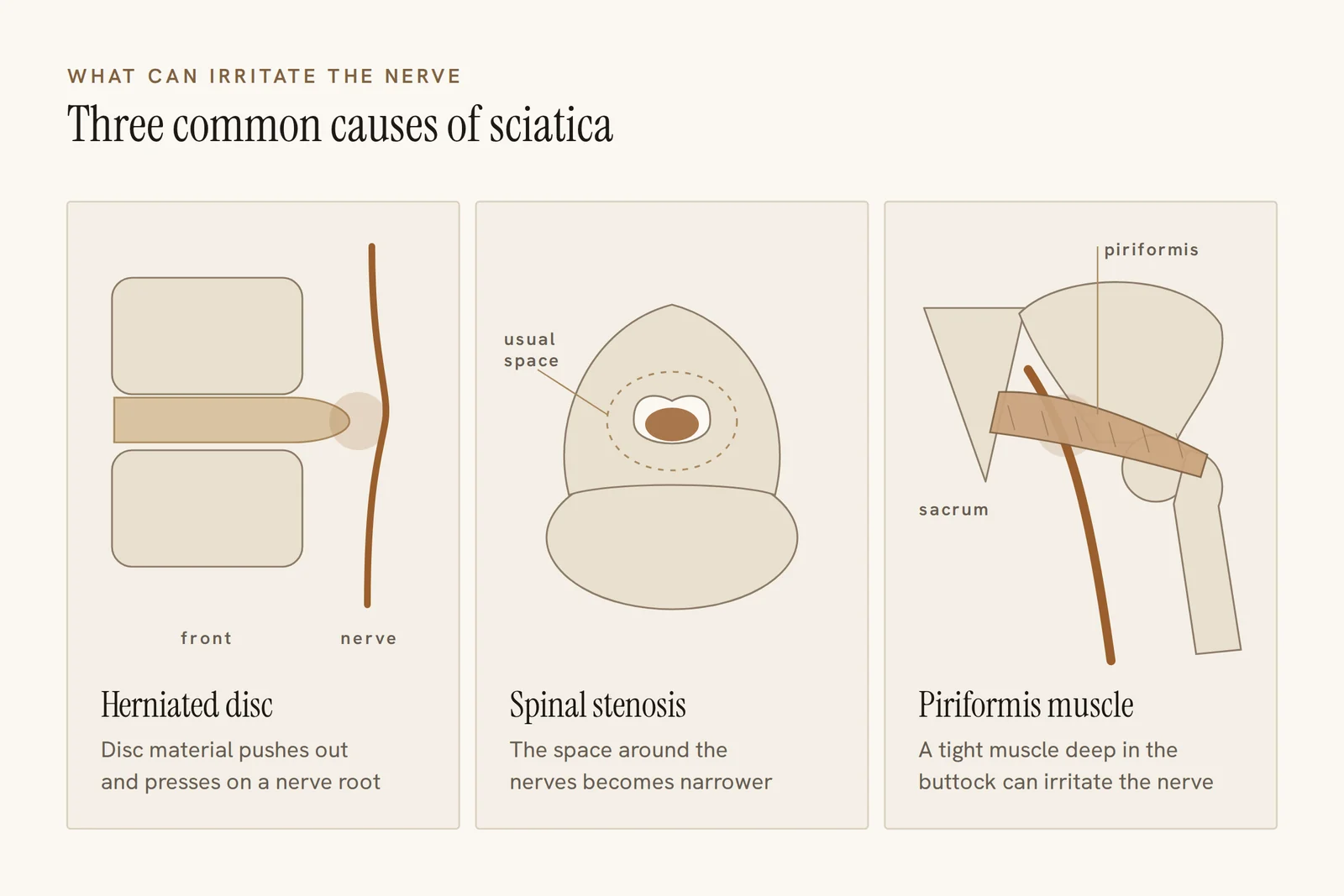
Sciatica happens when something pinches, presses on or irritates the sciatic nerve or one of the nerve roots that form it. Cleveland Clinic and MedlinePlus list several common causes:
- Herniated disk: the soft center of a spinal disk pushes out and presses on a nearby nerve root.
- Spinal stenosis: the space around the nerves in the spine narrows and crowds them.
- Piriformis syndrome: a pain problem involving the narrow piriformis muscle deep in the buttock.
- Spondylolisthesis: one vertebra slips forward over the one below it.
- Degenerative disk disease and osteoarthritis, which come with wear on the spine over time.
- Pregnancy, and less often, pelvic injury, tumors or cysts.
In some cases, providers cannot find a clear cause. The diagram below compares three of the most common causes side by side: a disk pressing on a nerve root, a narrowed spinal canal, and a tight piriformis muscle.
Risk factors you can influence
Cleveland Clinic notes that sitting for long periods, heavy lifting, weak core muscles, extra body weight, low activity and tobacco use can all raise your risk of sciatica.
That list hits close to home in Los Angeles, where many people work at a desk all day and then sit in traffic on the way home. MedlinePlus specifically suggests avoiding long periods of sitting with pressure on the buttocks.
If leg pain has lasted more than a few weeks or keeps coming back, Dr. Okhowat can look for what may be irritating the nerve and talk through your options.
Sciatica pain relief at home: what may help
If your symptoms are mild, self-care is a reasonable place to start. Cleveland Clinic suggests talking with a provider if things do not improve after a few weeks.
Keep moving, gently
Bed rest is not recommended for sciatica. A short rest during the first day or two may help, but too much rest can make pain worse and slow your recovery.
Short walks, changing positions often and easing back into normal activities are usually a better plan. MedlinePlus suggests avoiding heavy lifting and twisting for the first 6 weeks after the pain begins.
Ice first, then heat
Ice may help ease pain and swelling during the first few days. MedlinePlus suggests ice for the first 48 to 72 hours, then heat. Use either for about 20 minutes at a time, with a cloth between your skin and the pack.
Mind your posture
Sit with your back supported and your feet flat on the floor, and get up often if you work at a desk. When you lift, bend your knees and keep the load close to your body instead of bending at the waist.
Gentle sciatica stretches to try
Cleveland Clinic describes a few simple exercises that physical therapists often teach for sciatica. Move slowly, breathe, and keep each one well within a comfortable range.
One rule applies to all of them: stop if pain shoots down your leg, or if numbness or tingling gets worse. A mild stretch in your back or hip is fine. Spreading nerve pain is not.
- Knee to chest: Lie on your back with your knees bent. Bring one knee toward your chest and hold behind your thigh until you feel a gentle stretch. Hold for a few breaths, lower it, and switch sides.
- Cat and camel: Start on your hands and knees. Slowly round your back toward the ceiling, then let your belly drop and lift your chest. Move back and forth slowly for a few rounds.
- Bridge: Lie on your back with knees bent and feet flat, hip-width apart. Tighten your belly, squeeze your buttocks and lift your hips until your body forms a straight line. Hold a few seconds, then lower slowly.
- Lower back extension: Lie on your stomach with your hands under your shoulders. Keep your hips on the floor and gently press up to lift your chest, then lower slowly. Skip this one if bending backward makes your leg pain worse.
For more ideas, see these gentle stretches for lower back pain. If you are not sure which moves suit your body, a guided plan of corrective exercises can take out the guesswork.
What to avoid when sciatica flares
Habits that can make sciatica worse
- Staying in bed for days at a time
- Heavy lifting or twisting in the first weeks
- Sitting for hours without a break
- Pushing through a stretch that sends pain down your leg
- Jumping back into hard workouts before the pain settles
- Ignoring weakness, spreading numbness or bladder changes
When sciatica needs a doctor right away
Most sciatica is not an emergency. But some signs can point to serious nerve pressure, such as cauda equina syndrome, or to an infection or fracture. These need a physician or emergency care first.
See a doctor right away if
- You lose control of your bladder or bowels
- You have numbness in your groin, inner thighs or buttocks (the saddle area)
- Leg weakness is getting worse, or your foot starts to drag
- You have a fever along with back pain
- The pain started after a hard fall, car crash or other injury
- Pain is worse when you lie down or wakes you at night
- You are losing weight without trying
In an emergency, call 911. Otherwise, please see a physician or urgent care before booking chiropractic care.
MedlinePlus also advises contacting your provider if this episode feels different or worse than past back pain, or if it has lasted longer than 4 weeks.
When a physician may suggest more
If self-care and conservative care do not help, a physician may suggest prescription medicine, physical therapy or spinal injections. Imaging such as an MRI is usually saved for severe or worsening symptoms, and surgery is usually a last option.
How a chiropractic evaluation for sciatica works
Chiropractic care is one conservative option for sciatica treatment. At Okhowat Chiropractic, the first visit starts with a conversation about where your pain travels, what makes it better or worse, and what you want to get back to doing.
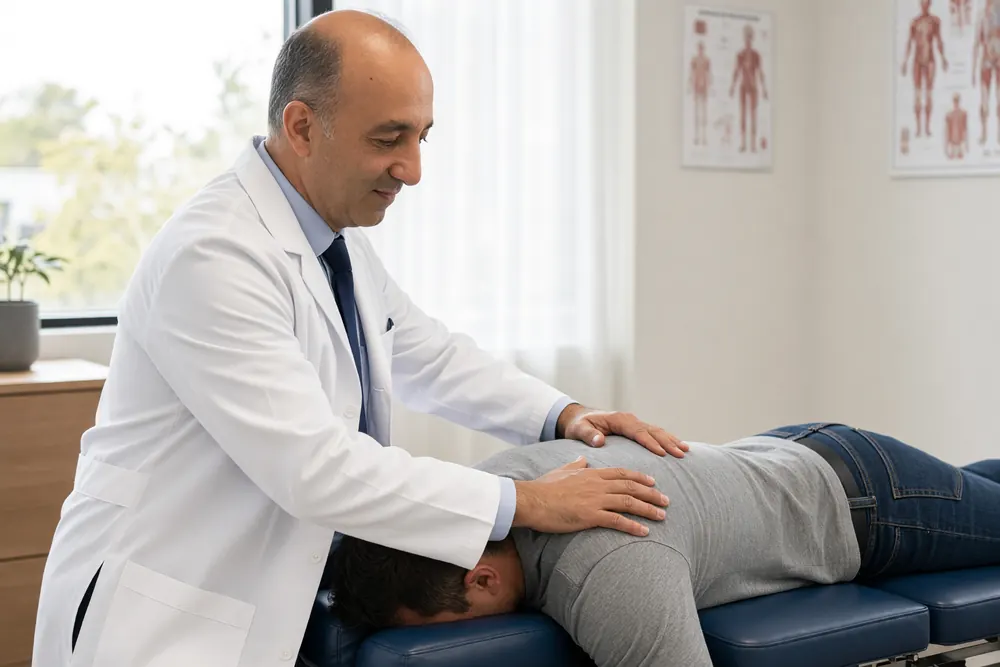
Next, Dr. Okhowat assesses your posture, movement, joints and muscles. He also screens for anything a physician should see first. Common exam steps for sciatica include watching how you walk, checking strength and reflexes, and a straight leg raise test.
From there, you get a personalized plan. Hands-on care may include spinal adjustments, soft tissue work for tight muscles in the low back and hips, and corrective exercise you can keep doing at home.
When a disk problem seems to be involved, gentle spinal decompression therapy may be discussed as part of the plan. This guide to herniated disc treatment without surgery explains how it works and who it may suit.
How Okhowat Chiropractic approaches sciatica
Dr. Omid Okhowat, DC, has been in practice since 1999 and has over 25 years of experience. He earned his Doctor of Chiropractic degree at Cleveland Chiropractic College and is a Diplomate of the College of Manipulative and Body Based Practices through the American Association of Integrative Medicine.
Each plan explains what he found, what he recommends, how often to come in, and how you will know it is working. The goal is not only short-term relief but also building the strength, posture and daily habits that help keep flare-ups from returning.
The office is at 6221 Wilshire Blvd, just west of Fairfax Avenue, near Mid Wilshire and Beverly Grove. Hours run Monday to Thursday 9 AM to 9 PM and Friday 9 AM to 5 PM. Contact the office or call (323) 933-3357 to set up a visit.
Ready to find out what is behind your leg pain? Book a consultation with Dr. Okhowat and get a clear, step by step plan.
Questions readers ask
How long does sciatica usually last?
Cleveland Clinic notes that many cases improve within four to six weeks, and sciatica often does not last longer than six weeks. More severe cases can take several weeks or months. If pain lasts longer than a few weeks or gets worse, talk with a provider.
Is walking good for sciatica?
For many people, yes. Light activity like walking can help you stay flexible and strong, while too much rest may slow recovery. Keep walks short and easy at first, and stop if leg pain spreads or numbness gets worse.
Should I use heat or ice for sciatica?
A common approach is ice for the first 48 to 72 hours, then heat. Use either for about 20 minutes at a time with a cloth layer to protect your skin. If one feels better than the other, that is a reasonable guide.
Can a chiropractor help with sciatica?
Chiropractic care is one conservative option many people with sciatica try. A chiropractor starts with an exam to look for the likely source of nerve irritation and to screen for red flags that need a physician. Care may include adjustments, soft tissue work and exercises, and results vary from person to person.
What is the fastest way to relieve sciatica pain at home?
There is no single quick trick. Gentle movement, ice or heat, over-the-counter pain relievers if they are safe for you, and breaking up long periods of sitting are common first steps. If pain is severe or comes with weakness, get checked instead of waiting it out.
How many chiropractic visits will I need for sciatica?
It depends on the exam, the likely cause and how your body responds to care. Dr. Okhowat explains how often he recommends coming in and how you will know the plan is working, then adjusts it as you improve.
Does insurance cover chiropractic care for sciatica?
Coverage depends on your plan. Okhowat Chiropractic accepts insurance, so call (323) 933-3357 to check your plan before your first visit.
Sources

About the author
Dr. Okhowat earned his Doctor of Chiropractic degree at Cleveland Chiropractic College and has practiced in Los Angeles since 1999. He is licensed by the California Board of Chiropractic Examiners and is a member of the American Chiropractic Association and the California Chiropractic Association.
- DC, Cleveland Chiropractic College
- AAIM Fellow
- AAIM Diplomate, Manipulative and Body Based Practices
- Over 25 years of experience
This article is general information, not medical advice, and is not a substitute for an exam. Please talk with a qualified provider about your situation. Individual results vary.