


The short answer
Whiplash is a neck sprain caused by a sudden backward then forward movement of the head, most often in rear-end collisions. Symptoms like neck pain, stiffness and headaches can start right away or take 12 hours to a few days to appear. Get checked by a physician first; after that, conservative care such as chiropractic care may help.
- Rear-end collisions are a common cause of whiplash
- Some symptoms appear 12 hours or more after a crash
- Numbness, weakness or vision changes need prompt medical care
- Most minor cases improve within days or a few weeks
A rear-end tap at a red light can feel like nothing at the time. Then the next morning your neck is stiff, checking your blind spot hurts, and a dull headache sits at the back of your head.
That pattern is common with whiplash from a car accident. In Los Angeles, where stop-and-go traffic on Wilshire and the 10 makes freeway fender-benders part of daily life, it helps to know the signs and when a car accident chiropractor can be part of your care.
This guide covers what whiplash is, which symptoms to watch for, why some show up late, and what conservative care can look like. If you were just in a crash and something feels seriously wrong, get emergency care first.
What is whiplash?
Whiplash is a neck injury caused by a sudden backward then forward movement of the head. Cleveland Clinic describes it as a form of neck (cervical) sprain that can damage the muscles, ligaments, bones and nerves of the neck.
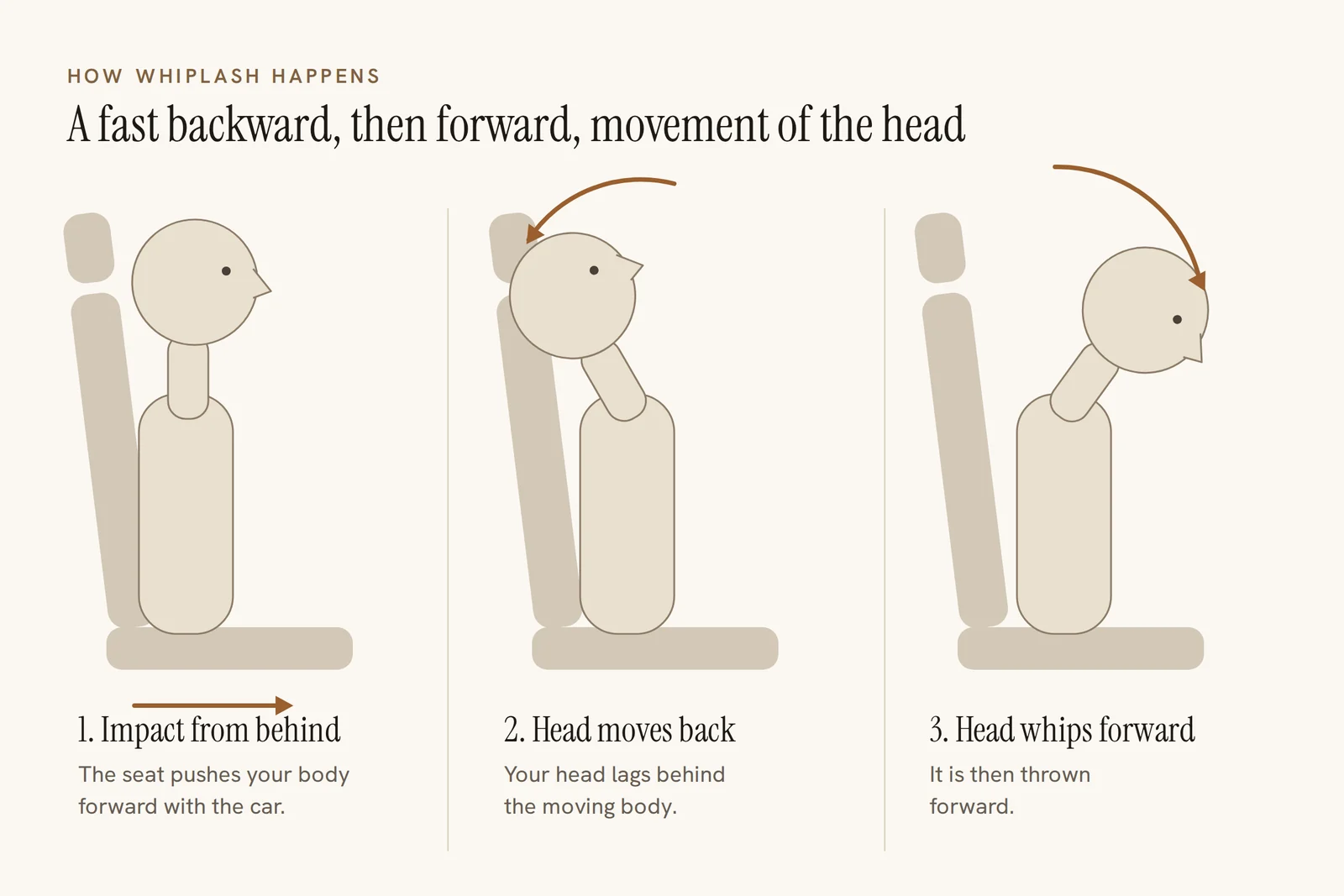
The motion happens in a split second. Your head is thrown back, then whipped forward, and the neck is pushed past what its muscles, ligaments and bones can handle.
The diagram below shows the three phases of a typical rear-end collision: the neck at rest, the head pushed back as the car lurches forward, and the head snapping forward as the body comes to a stop.
Common causes of whiplash
Rear-end collisions are the classic cause, but not the only one. Cleveland Clinic lists these common sources of whiplash injuries:
- Vehicle accidents, especially rear-end collisions
- Contact sports such as football, hockey and rugby
- Roller coasters
- Falls
Anyone can get whiplash at any age. Cleveland Clinic notes it is more likely to cause serious or lasting injuries in older adults and in women.
Whiplash symptoms to watch for
Whiplash symptoms range from mild to severe. Most cases are minor, but the list of possible signs is longer than many people expect.
- Neck pain, stiffness and tenderness near the injury
- Pain that spreads to your head, face, shoulder or shoulder blade
- Muscle spasms that make it hard to move your head
- Swelling around the injured area
- Headaches
- Muscle weakness
- Numbness, burning, tingling or pins and needles in the neck, upper back, shoulders or upper arms
- Dizziness or vertigo
- Vision problems
- Hoarseness, loss of voice or trouble swallowing
Some of these, like numbness, weakness, vision changes or trouble swallowing, are reasons to see a physician promptly rather than wait and see how you feel.
Neck pain that spreads upward can turn into regular headaches after a crash. If that becomes the main problem, headache care can be one part of a broader plan once a physician has ruled out anything serious.
Why whiplash symptoms can show up later
It surprises many people that they can walk away from a crash feeling fine. According to Cleveland Clinic, some whiplash symptoms begin right after a crash, while others take at least 12 hours to appear.
Sometimes it takes a full day or even a few days for all the symptoms to show up. That is one reason to pay attention to how your neck feels over the first week, not just the first hour.
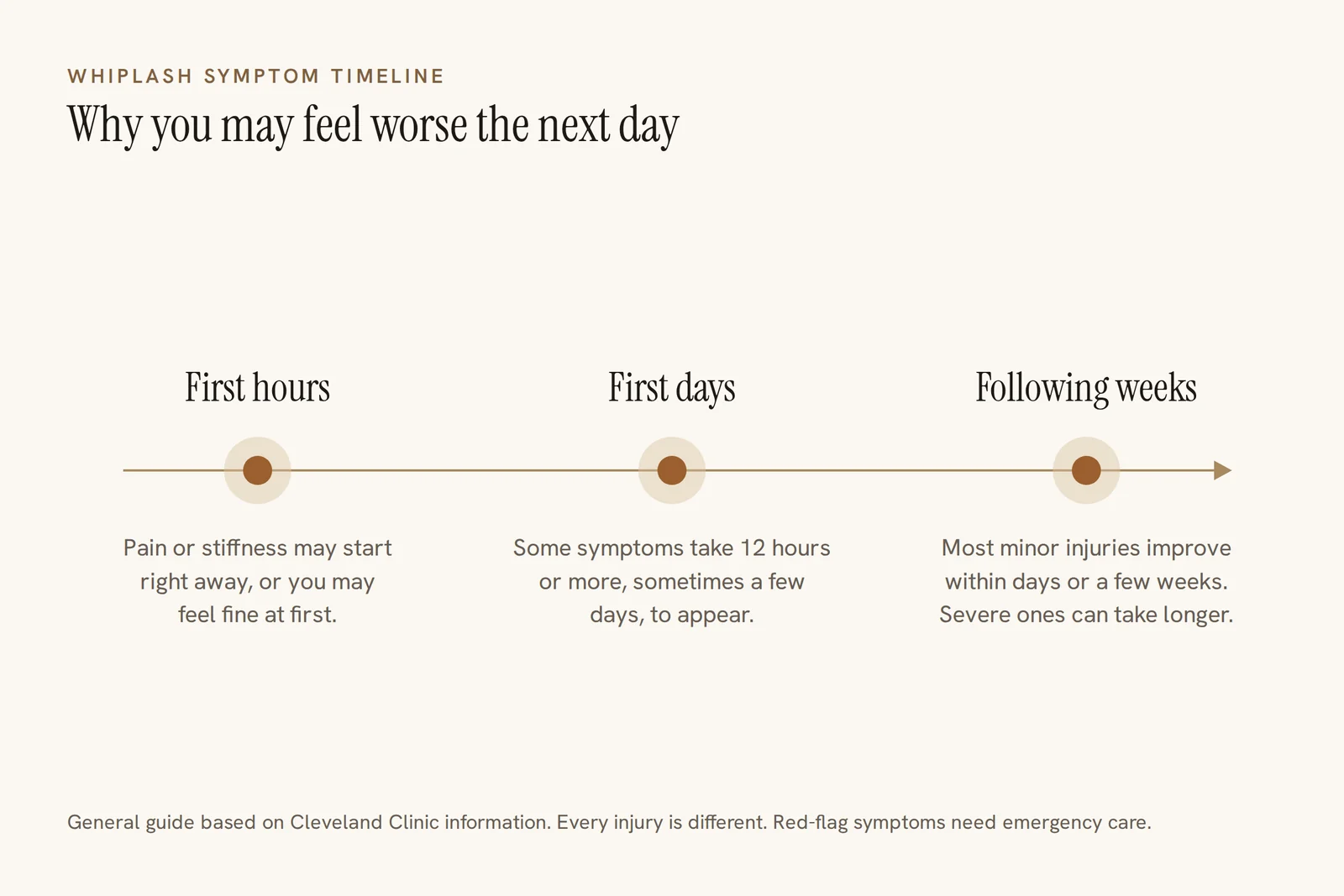
The first hours
Some people notice pain or stiffness right away. Others feel shaken up but mostly okay, and assume they escaped without injury.
The first days
Symptoms that take 12 hours or longer often make themselves known the next day: a stiff neck, soreness spreading into the shoulders, or a headache. For some people, it takes a few days for the full picture to appear.
The following weeks
Most people with a minor whiplash injury recover within days or a few weeks, according to Cleveland Clinic. More severe injuries can take several weeks or even months, and some people develop long-term pain or dizziness.
The timeline below sums this up. Use it as a general guide only, since every injury and every body is different.
What to do in the first days after a car accident
Your first job after a collision is safety and medical care. If you or anyone in the car has symptoms like the ones below, call 911 or go to the emergency room before anything else.
See a doctor right away if you have
- Loss of consciousness, confusion or a severe headache after the crash
- Numbness, tingling or weakness in your arms or legs
- Loss of coordination or trouble walking
- Loss of bladder or bowel control
- Severe neck pain or trouble moving your neck at all
- Vision problems, trouble swallowing or trouble speaking
- Headache with dizziness, nausea or vomiting
In an emergency, call 911. Otherwise, please see a physician or urgent care before booking chiropractic care.
Even without red flags, Cleveland Clinic says it is always a good idea to see your healthcare provider after a spine injury. They can make sure there is no serious damage and give you care instructions.
After a collision
- Get checked by a physician or urgent care, right away if you have any red-flag symptoms
- Use a cold pack wrapped in a thin towel for about 15 minutes at a time in the early days
- Add gentle heat later if your provider agrees
- Take pain medicine only as your physician or the label directs
- Move gently within comfort and skip heavy lifting or sports until you are cleared
- Keep a simple record of your symptoms and appointments
- Watch for new symptoms over the next few days, such as headaches or tingling
- Call your provider if your neck pain has not improved after one week
A short daily note on how your neck feels helps your providers see patterns, like headaches that build late in the day or stiffness that is slowly easing.
Still stiff or sore days after a collision? Book a consultation with Dr. Okhowat to have your neck checked and talk through conservative care options.
How whiplash is evaluated
A provider usually starts with questions about the crash, your symptoms and your health history, then does a physical exam and a neurological exam. The goal is to rule out other conditions and anything serious.
Depending on what they find, you may need X-rays, a CT scan or an MRI. Cleveland Clinic notes these tests can also help diagnose complications related to whiplash.
At Okhowat Chiropractic, the first visit follows the same careful order. Dr. Okhowat starts with a conversation about the accident and how you have felt since, then assesses your posture, movement, joints and muscles.
He also screens for anything that may need imaging or a physician's care first. If the exam points that way, that step comes before any chiropractic care.

Once that screening is done, the conversation turns to a plan: what he found, what he recommends, how often, and how you will know it is working.
Conservative whiplash treatment options
Cleveland Clinic says the goal of whiplash treatment is to let your neck heal as much as possible on its own while keeping symptoms down. For most people, that means conservative care rather than surgery.
Rest, then gentle movement
A little rest can feel right in the first days after a crash. After that, gentle movement as your provider advises can help you ease back into normal activity.
Ice and heat
Your provider may have you use hot or cold packs on your neck for the first 7 to 10 days. Cold comes first right after the injury, and heat can be added later to loosen tight muscles and promote blood flow.
Medicine from your physician
Pain relievers, anti-inflammatory medicines and muscle relaxers can help manage whiplash symptoms. Your physician can tell you which, if any, make sense for you.
Physical therapy and exercise
Cleveland Clinic lists physical therapy among the most common whiplash treatments. Guided exercises can help strengthen injured areas after they heal.
Chiropractic care and soft tissue work
Chiropractic care is one conservative option people use alongside medical care. For neck pain in general, Cleveland Clinic lists chiropractic care and massage among the alternative therapies a provider may recommend.
Depending on your exam, a plan may include gentle spinal adjustments, soft tissue therapy for tight, guarded muscles, and exercises to rebuild strength. Whether adjustments are a good fit depends on what the exam shows.
Surgery is rare. Cleveland Clinic notes it may be needed in uncommon cases such as disk herniations or fractured vertebrae.
How Dr. Okhowat approaches care after a car accident
Dr. Omid Okhowat, DC, has been in practice since 1999 and has over 25 years of experience. He earned his Doctor of Chiropractic degree at Cleveland Chiropractic College and is licensed by the California Board of Chiropractic Examiners.
His care follows a clear sequence. First comes the consultation and exam, including screening for anything a physician should see first. Then you get a personalized plan that spells out what he found, what he recommends, how often, and how you will know it is working.
Hands-on care may include adjustments, soft tissue work and corrective exercise. As you improve, the focus shifts to recovery and prevention: strength, posture and daily habits, such as how your car seat and headrest are set up.
If you are dealing with neck pain or other symptoms after a recent accident or trauma, the office is at 6221 Wilshire Blvd #326 in Los Angeles, just west of Fairfax Avenue. Hours are Monday to Thursday 9 AM to 9 PM and Friday 9 AM to 5 PM.
You can call (323) 933-3357 or use the contact page to request an appointment. If long days at a screen also leave your neck tight, the guide to tech neck covers posture habits that can help.
Hurt in a recent collision? Call (323) 933-3357 to book a consultation with Dr. Okhowat and get a clear, step-by-step plan for your neck.
Questions readers ask
How long does whiplash last after a car accident?
Most people with a minor whiplash injury recover within days or a few weeks, according to Cleveland Clinic. More severe injuries can take several weeks or months, and some people develop long-term pain. If your neck is not improving after a week, check in with a provider.
Can whiplash symptoms show up days after a crash?
Yes. Some symptoms start right away, while others take at least 12 hours to appear. Sometimes it takes a full day or a few days for all of them to show up, so keep an eye out for new stiffness, headaches or tingling.
Should I see a doctor or a chiropractor first after a car accident?
If you have any red-flag symptoms, go to the emergency room or call 911. Otherwise, it is wise to be checked by a physician after any spine injury. Chiropractic care can be one conservative option after that, and Dr. Okhowat screens for anything that needs a physician first.
Is it safe to see a chiropractor for whiplash?
That depends on your exam. Dr. Okhowat assesses your neck and screens for anything that may need imaging or a physician before starting care. If adjustments are not a good fit, care can focus on other options such as soft tissue work and guided exercise.
Should I use ice or heat for whiplash?
Cold is the usual first choice right after an injury because it narrows blood vessels and can reduce swelling. Heat can help loosen tight muscles later on. Use either for about 15 minutes at a time, with a towel between the pack and your skin.
How many chiropractic visits will I need for whiplash?
There is no set number. It depends on what the exam shows, how the injury is healing and how you respond to care. Dr. Okhowat explains how often he recommends visits and how you will know the plan is working.
Can whiplash cause headaches and dizziness?
Yes. Cleveland Clinic lists headaches, dizziness and vertigo among possible whiplash symptoms, and neck pain can spread into the head. A sudden severe headache, or dizziness with nausea or vomiting, needs prompt medical attention.
Sources

About the author
Dr. Okhowat earned his Doctor of Chiropractic degree at Cleveland Chiropractic College and has practiced in Los Angeles since 1999. He is licensed by the California Board of Chiropractic Examiners and is a member of the American Chiropractic Association and the California Chiropractic Association.
- DC, Cleveland Chiropractic College
- AAIM Fellow
- AAIM Diplomate, Manipulative and Body Based Practices
- Over 25 years of experience
This article is general information, not medical advice, and is not a substitute for an exam. Please talk with a qualified provider about your situation. Individual results vary.